Innovation Management &
New Product Development
3rd Edition
By Paul Trott
Financial Times / Prentice Hall
September 2005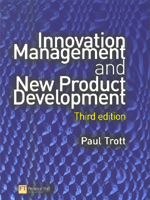
ISBN: 0273686437
536 Pages, Illustrated, 7 ½" x 9 ¾"
$97.50 Paper Original
The subject of innovation management is often treated as a series of separate specialisms, rather than an integrated task. The main aim of this book, however, is to bring together the areas of innovation management and new product development and to keep a strong emphasis on innovation as a management process.
Written in an accessible style, this third edition brings a change in structure to clearly set out three key areas for the student: Innovation management, managing technology and knowledge and new product development. This book will be suitable for undergraduates and postgraduates on a wide range of courses from marketing, strategic management, business studies and engineering.
Contents
PART ONE: INNOVATION MANAGEMENT
1. Innovation Management: An Introduction
2. Macro factors and Innovation
3. Managing Innovation Within Firms
4. Innovation and Operations Management
5.Managing Intellectual property
PART TWO: MANAGING TECHNOLOGY AND KNOWLEDGE
6. Managing Organisational Knowledge
7. Strategic Alliances And Networks
8. Management of Research & Development
9. Managing R&D projects
10. The Role Of Technology Transfer In Innovation
PART THREE: NEW PRODUCT DEVELOPMENT
11. Product & Brand Strategy
12. New Product Development
13. Packaging and Product Development
14. The Role Of Market Research In New Product Development
15. Managing The New Product Development Team
" Topical articles from the Financial Times illustrate how the subject is
being discussed in the context of the wider business world.
" Full of up-to-date examples integrated into the text to help enliven the
concepts for students.
" Comprehensive diagrams throughout the book illustrate some of the more complex
concepts to students.
" A substantial case study at the end of each chapter shows the student how
the subject is applied within actual firms.
" Clear chapter openers set the scene for the chapter, and learning objectives
bullet the key areas that will be explored.
" Summaries at the end of each chapter provide a useful means of revising,
checking and understanding.
" Extensive up-to-date reference and relevant literature, enabling students
to dig deeper into the subject.
Return to the Businesss Titles Home Page