New Investor's Toolbox
Using the Right Tools to Fine Tune Your Financial
Future
By Henry Harington & Alexander Hoar
Pearson Education / Financial Times
January 2004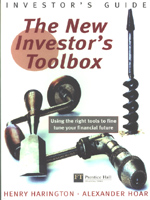
ISBN: 0-273-66308-9
264 Pages, Illustrated, 6 ¼" x 9 ¼"
$55.00 paper original
As a private investor, mistimed or misplaced usage of financial instruments, or reliance on just a couple of financial tools can mean that you're not equipped to cope with the bear as well as the bull markets. The professionals use a whole range of financial instruments to tune their portfolios to the markets. There is no reason why private investors can't do the same. This book helps you to use these tools to tailor your portfolio, by identifying your risk and vulnerabilities and knowing where to go from there. The emphasis of the book is on equipping the investor with enough knowledge of the different tools at your disposal to be able to use the right ones at the right time to minimize losses and maximize gains. Aimed at retail investors, this text gives access to the strategies used by city professionals enabling them to protect and grow their wealth successfully.
Contents
What the book is going to achieve Why it is important to have a New Financial
Toolbox The future and potential dangers of investing in the new century
Chapter 1 - The Foundations ~ The Secrets – Of Successful Trading Common sense
Risk/Reward combined with probabilities Understand what you’re doing, how
you will achieve it and then doing it
Chapter 2 - Risk Control - Why It Pays To Lose Less Understanding Risk & Reward
The Risk/Reward ratio – Where do you want to be located The hidden damage
of losses Treat your trading like a business Is losing is OK? Risk is ultimately
more important than reward How do the professionals play the risk/reward ratio
Start with your risk and then reward How to correctly set up a trade When
are tips good – Be humble and realistic
Chapter 3 - Simple & Effective Charting Analysis – Keep It Simple, Keep It
Quick The use of computers What you don’t know can’t harm you The best charting
is the simple kind A closer look at charts – What types are best Look across
different timeframes Flowing markets Trading ranges Support/resistance levels
and how to use them 10 second chart analsisy Technical indicators – Good or
bad Context – It’s all important Using charts as a safeguard – Back to risk
Use charts to quickly understand any market or stock Sector relationships
using charts Use charts to define probabilities and risk/reward calculations
Cost effective ways to simply and effectively chart the stock market
Chapter 4 – Stop Losses – Critical, Critical, Critical What is a stop loss
How does a stop work Why use stops – It’s important to know your loss Keeping
risk constant letting risk vary – Trade like the professionals Types of stop
loss orders Use them to protect profits Problems with using stop losses Brokers
and stop loss orders Golden rules to use when setting stop losses Where should
stop losses be placed Stop losses and the risk/reward ratio – Now you’ve got
something very powerful
Chapter 5 - Short Selling – Great Flexibility What is short selling How is
short selling handled in today’s markets Short selling gets a bad name Is
it that dangerous in today’s markets Short selling – adding more flexibility
to your toolbox Simple and effective rules for successful short selling
Chapter 6 - CFDs – Yet more Flexibility What are CFDs Why were they developed
How they work Advantages & disadvantages Shorting stock – A new addition to
your toolbox Pairs trading – What is it How to trade pairs
Chapter 7 - Traded Options – Total Flexibility What are options Why were they
developed Who uses options Option terminology How are options priced Volatility
– What nobody really speaks about What option strikes to buy/sell What months
to buy/sell How to use option volatility Buying options – Pros & cons Selling
options short – Pros & cons Option strategies – The best way forward Speculation
and options Hedging and options – You insure your car and house, why not your
portfolio Income enhancement and options Advantages and disadvantages of using
options Good rules for successful trading of options
Chapter 8 - How To Effectively Build Options Into Your Portfolio Why do you
want to use options? To make money is not a good enough answer! Watch those
spreads – How to get inside the bid/offer Play the game on your terms – Not
the market makers or the brokers When best to buy options When best to sell
options Using options for income enhancement How to buy stock at less than
today’s price using options Guaranteed ‘free’ stop losses using options Spike
trading on stocks using options More option strategies
Chapter 9 - Futures – Only For The Dedicated What are futures Why were they
developed How they work Using futures within your portfolio Simple rules to
keep you out of trouble
Chapter 10 - Spread Betting – Tax Free Has It’s Advantages Tax free, yes –
Advantage, maybe? Why where they developed How do they work Why Spread betting
should be part of your financial toolbox When you should use spread bets When
you should not use them Simple rules to keep you out of trouble
Chapter 11 - Sector Funds – ETFs The New Stockmarket Trading Vehicles? How
sector relationships can help your trading It’s all about momentum What are
ETFs Why they were developed What ETFs are traded How to buy and sell ETFs
Future trading with ETFs – Time to get clever
Chapter 12 - Hedge Funds – Do They Really Hedge? What are they Why were they
developed Should you invest in them How to find a good Hedge Fund On balance
small funds are better
Chapter 13 - Foreign Shares – Don’t Overlook Them – Returns Are Returns This
is a global market Dollars, €uros, it’s all profit This is where charts are
so useful Information is plentiful How to trade Foreign shares
Chapter 14 - Information – There’s Too Much – You’ve Got To Sort It The information
age is truly upon us Too much information dilutes its use Where to find the
best information Working the web Don’t overload Again, what you don’t know
often can’t hurt you Brokers reports – The tooth fairy visits What recent
history has taught us about market commentators Use information as a contrary
indicator
Chapter 15 - Future Market Scenarios – Can Your Investments Handle The Uncertain
Future? What can go wrong - There’s almost too much The damage that disasters
can have on your portfolio How to combat this problem What if nothing happens?
– It’s a win-win Preparing for the worst
Chapter 16 – Conclusions
Glossary As long as is necessary – At InvestorProfit we’ve got over 4000 financial
words and phrases we can use.
Return to the Businesss Titles Home
Page